So I'm not going to talk about my school day. Instead, I'm going to finish telling you about the Epic of Gilgamesh. Did I ever tell you the end of Gilgamesh?
It's a great ending. In MY opinion, it's a great ending. I'll just tell you the story. I really like it.
So Gilgamesh starts off as this super arrogant, cocky king who keeps stealing his subjects' wives to have sex with. He's 2/3 god, and super handsome, but super lame. I sort of think of him as Brad Pitt in Troy:

The people pray to the gods, "Hey gods! Do something about this jerk!!" So the gods create Enkidu (ink-a-doo) to come and contend with him. Enkidu's half animal and supposedly has more "street sense" than Gil-- like, he's more connected with the earth. Supposedly. I kind of think of him as Wolverine.
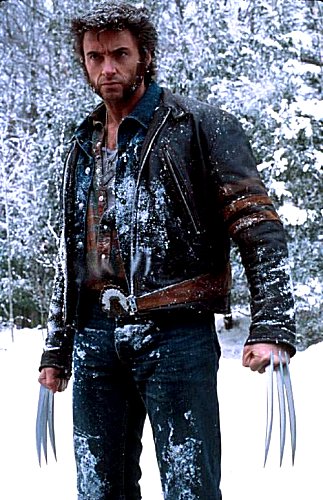
Enkidu runs into Gilgamesh when Gilgamesh is about to steal a bride from a new hubby, and Enkidu says, "Excuse me homespice, I DON'T THINK SO," and they FIGHT, and Gilgamesh wins, but he decides that he likes Enkidu anyway. Because. Enkidu is scrappy.
So now they're buddies, and Shamash, the sun god, suggests that they go fight the gnarly scary Forest Guardian, Humbaba, to get immortal fame. Enkidu-- street sense, remember-- says, "That is insane, that is a suicide mission; YOU can do it if you want, and I'll go tell your mother that you're dead. Because that's what's going to happen."
Gilgamesh says, "No way, it's not my day to die, we are going to KILL this monster!" And he convinces Enkidu to fight. But as soon as Humbaba ROARS out of his lair, Gilgamesh runs away like a PANSY. I think of Humbaba like this:

So Gilgamesh runs away and hides behind a tree, and Enkidu says, "Dude?!! You can't leave me alone here! Remember your big boasts?!" So Gilgamesh comes out, prays to the gods; they send massive WINDS which make Humbaba all disoriented, and then Gilgamesh and Enkidu beat him. Humbaba begs for his life and Gilgamesh ALMOST lets him live, but smarty-pants Enkidu says, "Bad idea," and they kill him.
They take his giant head to the Earth god, Enlil. But Enlil-- the EARTH god-- is not so happy with the two of them for killing his forest guardian. Instead of blessing them, he curses them. Big bad curse. They get cursed a few more times by a few more gods, and Enkidu ends up taking the fall. The gods can't kill Gil, because he's 2/3 god-- he's part of the country club. So they kill Enkidu instead. BUMMER.
Gilgamesh freaks out when his best friend dies, not only because he's sad to lose Enkidu, but also because he's suddenly aware of his own mortality. He decides that immortal fame isn't good enough for him: he has to figure out how to REALLY become immortal. So he goes to the end of the earth and talks to this guy named Utnapishtim who is basically Noah-- Utnapishtim gained immortality by surviving a worldwide flood on a boat with his family and two of every animal.

Gilgamesh goes to Utnapishtim and says, "How did you become immortal??"
And Utnapishtim says, "I survived a flood that wiped out the rest of humanity several thousand years ago, and the gods decided to make me immortal afterwards."
And Gilgamesh says, "What?? I can't become immortal that way!!"
And Utnapishtim says, "No duh."
And Gilgamesh says, "Well you've lived forever-- don't you know of SOME way that I can become immortal?"
And Utnapishtim, who is this grumpy old codger by now, smirks and says, "Ummm.... SURE I do... If you can stay awake for seven days and seven nights: you'll be immortal."
But Gilgamesh IS mortal, and he can't stay awake. He fails the test. Big time-- he ends up SLEEPING for almost seven days, instead of staying awake. He finally wakes up, and tries to lie to Utnapishtim, saying that he never REALLY fell asleep. But Utnapishtim is a smart grumpy old guy, and had had his wife bake a loaf of bread for each day Gil slept. He shows Gilgamesh the loaf baked on the first day and says, "See? It's moldy now. THAT'S how long you've been sleeping!" Gilgamesh is totally despondent. "I couldn't DOOO it...!"
But Utnapishtim's wife feels kind of sorry for Gilgamesh and tells her husband, "Come on honey. Have a heart. He's traveled all this way, and he's really tired... Can't we give him SOMETHING to take back to his people?"
So Utnapishtim grunts and says, "Fine. There's a plant at the bottom of the ocean that will give you eternal youth. If you go and get the plant, and eat it... You'll be forever young."
So Gilgamesh says, "GREAT!" And he goes and gets the plant. And for the first time, we see him acting a degree less selfishly, because instead of just devouring the plant himself, he says, "You know what? I'm going to give this to all the old men in my city FIRST... And THEN I'll have some for myself."
BUT: as he's swimming, a snake comes up, eats the plant, immediately sloughs its skin and becomes a young snake, and swims away. And the magic plant is gone. And Gilgamesh ends up with nothing.
And that's how the story ends! The last picture of Gilgamesh is returning home to his city with NOTHING, standing over the walls of his city, and saying: "You know what? This is a great city. It's strong. The people are great. I can be content with this." And the narrator ends the story by describing him as a WISE king, who knew the countries of the world, and who brought back a story of the days before the flood.
I LOVE that.
I love that Gilgamesh doesn't get the magic gimmick to bring home-- he has to be content with being just a little wiser, a little more humble, and having a story to tell. I love that because we usually DON'T get the magic plant to take home-- we usually have to be content with the wisdom we've gained after a long, tiring journey. Modern hero stories don't give us that kind of ending-- modern heroes get the fame, they win the battle, they get the girl, or something similar. You have to WIN in the modern stories.
But this ancient epic ends with its hero-- its HERO-- simply surveying his city, and taking a big breath in, and heaving a big sigh out, and saying, "Okay. This is what I've got. I'm going to be a good king now. I'm going to take care of my people. And one day, I'm going to die, but so be it. I'll do the best with what I've got."
And the great part is-- we're still talking about him. He probably thought that he was a failure-- he never DID become immortal and that was what he was searching for, after all. But his story was enough to keep his memory around for thousands of years. He is still talked about as a HERO-- for only being a little wiser, and for having a story to tell. I love that. I love that our hero story ends with simply a big breath in... And a big sigh out.
And as I do the same, it helps me return to the classroom with new resolve. So many of the kids didn't turn in their essays today-- after I spent literally hours working one-on-one with many of them. They didn't get them done. So much for the magic plant; so much for the tangible marker of success. But I can't have gained nothing from this experience-- I know the kids a tiny bit better, I've had a few more quality conversations, I'm learning how to talk to them, how to GET to them, how to navigate their personal loads that they come in with. I WILL get wiser through these difficult days. And hopefully, as I do, I'll learn how to be a better "leader" to these kids that are shrugging and shuffling their way into our classroom, and shrugging and shuffling their way into my heart.
They matter. Their lives MATTER.
So I'll do my best to be a Gilgamesh type of hero... And keep trying.


No comments:
Post a Comment